

Exploring the Vézère Valley


Where is the Vézère Valley located?
The Vézère Valley is located in the heart of the Dordogne department, near the “Purple Périgord,” in southwestern France—a must-see during your camping trip in the Dordogne. It’s located 23 km east of Sarlat-la-Canéda, an iconic medieval town in the Périgord Noir region that has been named one of the most beautiful villages in France. It’s also a two-hour drive east of Bordeaux, two and a half hours north of Toulouse, and one hour and forty-five minutes south of Limoges—and very close to our campground with a pool in the Dordogne.
The Vézère Valley is one of the most beautiful tourist destinations in the Dordogne. It is known for its prehistoric sites and is beloved for the beauty of its landscapes, the richness of its heritage, and the diversity of its cuisine in the heart of the Dordogne Périgord.
Valley of Prehistory
The Vézère Valley, located very close to the Dordogne Valley, is the place to go in the Dordogne for wonderful cultural discoveries surrounded by nature. Spread out over some 50 kilometers are some of the richest and most impressive sites of European prehistory, such as the Lascaux Cave, which bear witness to 400,000 years of human occupation. Thousands of stone tools, bone artifacts, and works of art have been discovered in these sites, offering a deeper understanding of the environment and way of life of the first humans who lived in the valley. The valley is also home to 147 Paleolithic sites and twenty-five decorated caves. It’s a must-see for anyone visiting the Dordogne and staying at our fishing campground in the Périgord.
Fifteen of the prehistoric sites in the Vézère Valley are designated as UNESCO World Heritage Sites. Among them are the Cro-Magnon rock shelter, the Micoque archaeological site, the Combarelles Valley, and the Rouffignac Cave. Other sites are listed as historic monuments in France, notably Regourdou, Bara-Bahau, and Castel Merle.
The Vézère River
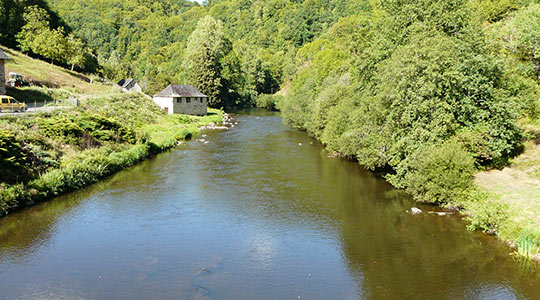
The Vézère River originates in the Longéroux peat bog, on the Millevaches Plateau in the Massif Central in Corrèze, at an elevation of 887 meters. It flows into the Dordogne River from the right bank in the town of Limeuil. The Vézère also flows through Terrasson, Montignac, Les Eyzies, and Le Bugue, and runs very close to our campground, Le Bugue.
The Dordogne River offers the perfect setting for vacationers looking to reconnect with nature. The tranquility here is incredibly rejuvenating, and the beauty of the surroundings is ideal for getting away from it all and experiencing a change of scenery. Visitors can also enjoy a variety of water activities, such as swimming or canoeing on the Dordogne.
What activities can you do on the Vézère River?
The Vézère Valley is a paradise for nature lovers. Whether you visit alone, as a couple, with family, or with friends, you’ll have the chance to appreciate the beauty of the area. A variety of activities await vacationers in this lovely valley. Walking, hiking in the Dordogne, and Nordic walking are among the most popular activities, allowing you to explore this rich region. Horseback riding, meanwhile, promises a truly unique experience. This activity is suitable for both beginners and experienced riders.
If you’re renting a mobile home in the Dordogne, you can also explore the Vézère Valley by canoe, boat, or stand-up paddleboard. It’s the perfect opportunity to admire, among other things, the steep cliffs along which the river flows peacefully, and where several caves and troglodyte dwellings are nestled, set among iconic castles and gardens. The river also flows through several quaint villages where you can enjoy a picnic, take a stroll…
The Castles of the Vézère Valley
The Fortified House of Reignac is one of the must-see attractions in the Vézère Valley. This 16th-century building, designated a historic monument, is the last intact example of a “cliff castle” in France. It offers a breathtaking view of the Vézère River.
Among the places worth visiting during your stay at our nature campground in the Dordogne is the Château de Losse, a 16th-century castle located on the riverbank. Commarque Castle, dating from the 12th century, offers a beautiful view of the Beune Valley.